Homeowners almost invariably look for comfort along with great energy efficiency in their newly constructed homes, barndominium owners even more so. After investing in quality insulation, energy efficient windows, and Energy Star appliances or better, solar energy is usually the next consideration. Investing in solar power makes sense for so many reasons: it is completely sustainable, it can save you money on your energy bills, it is a green energy source, and it can reduce your carbon footprint.
Before you decide to invest in solar energy for your home, however, it is best to determine what your goals are.
Solar Goals
Many people like the idea of solar energy but fail to invest in it for their home because they fear it will cost too much. How much it will cost depends on a number of things, the first being: What is your goal? Goals can vary from knowing that your home has an emergency power source during blackouts to generating all of your power and more to sell back to the electric company. Once you have decided what you want out of a solar system, then it is possible to find out how much that solar investment would cost.
The cost of a solar system is usually considered in terms of solar payback. Solar payback is the calculation of when the savings your solar system generates will make up for the initial cost of the solar system, and it varies widely from project to project.
There are many variables that will affect the ability of your system to meet your goals, and they will affect the cost of your system. The main variables are listed here:
• Who will you purchase your solar system components from? There can be big variations in price and quality.
• Are you installing the system yourself or paying someone else to do so? What does installation cost in your area?
• The climate will affect payback; if you live on a sunny patch in Florida, you are likely to reap more solar energy than someone living in Seattle, Washington where they enjoy fewer sunny days.
• The ability of your system to capture solar will be lessened if the panels are shaded part of the day by trees, buildings, or other obstructions.
• Will the panels be placed to face the direction which affords the best sun exposure? Will the roof or rack provide the best angle for solar collection?
• The energy needs of your household is very important in this equation if you are trying to provide all of your energy through solar. How many of your appliances use electricity? How efficient are those appliances? How much energy-powered activity goes on in your household: do you have TVs, lights, computers, washer, dryer, dishwasher, and other electric powered items running much of the time?
• What does energy from your local provider cost and if you sell energy to them what rate will they pay you for it?
• The cost of energy in the future will have an effect too, but of course you can only guesstimate what the future may hold.
All of these variables combined with your solar goal will tell you what your payback time is likely to be. Solar installers can help you figure out your solar payback, or you can use an online estimator such as https://sunroof.withgoogle.com/.
Solar as Emergency Power
Dwayne Borkholder, President of New Energy Homes, a division of Borkholder Building Supply has a long history working in the building industry and a long-time interest in energy efficiency. In 2017, his Net Zero Home received a Building of the Year award from the National Frame Building Association (NFBA). Net Zero means the home produces as much energy as it consumes which is all provided through a renewable resource.
Borkholder looks at home solar use as having 3 main stages:
-Producing enough energy to run your home during emergency situations
-Supplementing the utility’s energy production and dropping your energy costs
-Providing all of the energy your home uses
Borkholder said, “Know what your end goal is.” His own home is an example of using solar to achieve a particular goal. He lives in an old farmhouse that he renovated, improving efficiency immensely. When it came time to add solar, he decided that his immediate goal was to provide emergency back-up power and not invest more in the system than he could recoup based on the length of time he plans to reside in his current home.
He figured out how much energy he needed to live for three days including running his furnace, lights, refrigerator, water heater, and stove. Then he installed solar panels and backed them up with a battery bank and an LP generator so that if a power blackout continued beyond three days, he could use the LP generator to recharge the system in two hours, and he would have power for another two or three days.
While this system is primarily for emergency power, it provides energy to the Borkholder household all morning through the battery bank and usually runs out midafternoon. Borkholder has plans for a more advanced system in the future, but for now this system achieves his goals.
Total Solar Without Storage
Mark Schmid, a homeowner who has maintained various solar systems in his own homes for thirty years has a different solar goal. He wants to avoid dependency on fossil fuels, cut down on harmful emissions, and save money. Ultimately his goal is for his home to be Net Zero, producing as much energy as his household uses or more.
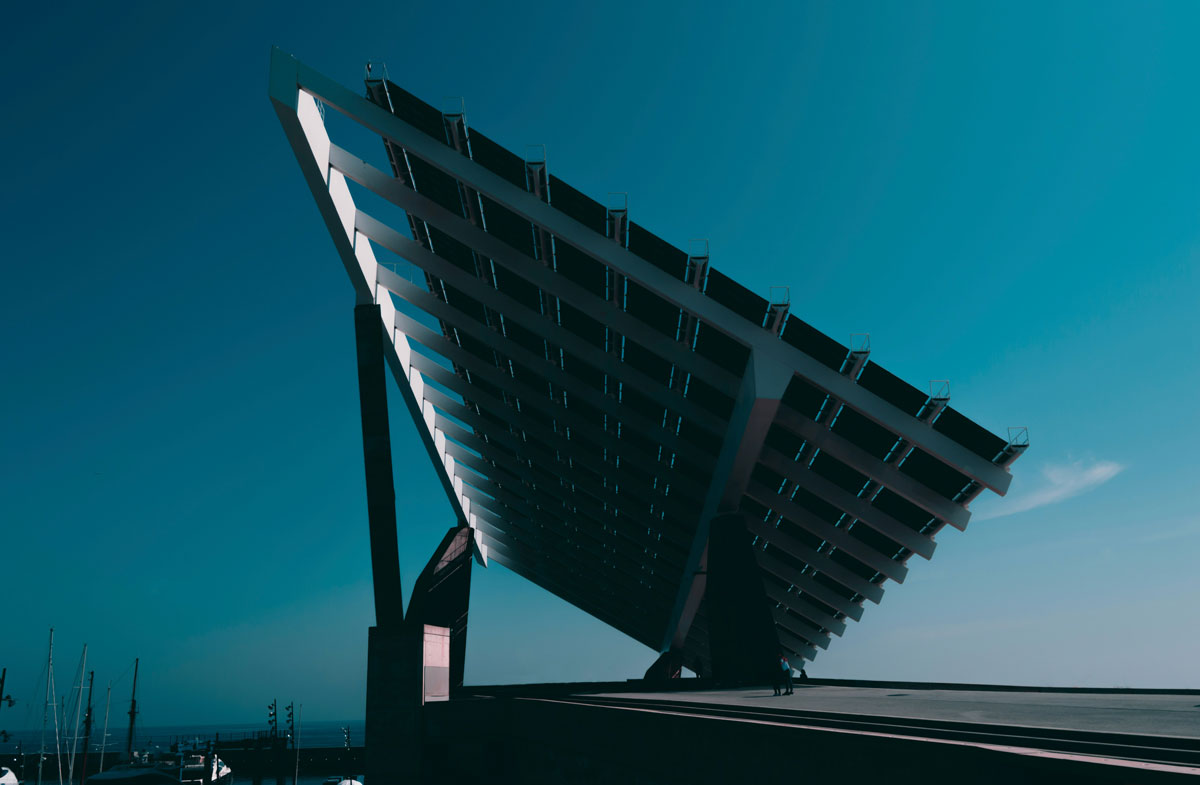
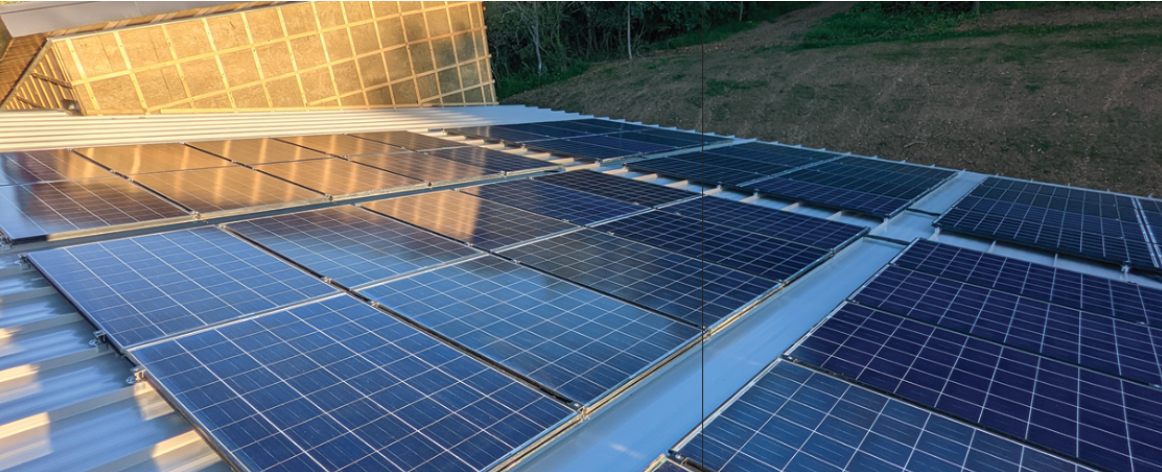
In order to achieve this goal, he has actually invested in two solar systems; one features solar panels atop his home and garage, and the other has panels mounted on a rack in his backyard. All panels enjoy a southern exposure with a bit of shading from trees. Altogether the two systems cost Schmid about $7,700, after 30% solar rebates from the government. Why were these systems so economical compared to some systems people have had installed? Schmid did the planning, buying, and installing himself.
The backyard rack which produces 3.2 kilowatts has paid for itself already. The rooftop solar system produces 7.2 kilowatts and is expected to pay for itself at the end of next year, or five years altogether. This is considered to be a very good solar payback. Fifteen-to-twenty-year payback is a more common outcome.
These systems put out enough energy to power Schmid’s home including heat, air, hot water, refrigerator, stove, dishwasher, computers, TV, and more…And it powers Schmid’s electric car which does about 15,000 miles a year.
“During the summer we make up for the power we draw from the electric grid in the winter, so in effect, we are paying $22 per month, sometimes a bit more or less, which is about what the utility company charges us for being on the grid,” Schmid said.
He continued, “I put these systems together myself. I researched and found the components I wanted based on my utility company’s requirements. They weren’t the cheapest components available; they were the best deal which takes into account the quality and longevity of the parts.”
He purchased Tier 1 solar panels which means they have an expected life of twenty-five years. He spent time looking for the best price on these quality panels and found them online; they were three years old but never used and still had twenty-two years left on the warranty. The inverter brand had such a good reputation for longevity that although the manufacturer went out of business, the seller gave him a 3-year warranty on them. The other components include racks and standard electrical components; there are no batteries included in either of these systems. At some point in the future, he plans to add batteries in case of long power blackouts.
“We save a lot of money with our solar system, but it is also worth it to me to install solar in a house because it is an investment in the future, it’s similar to planting a tree,” he said.
Living Off the Grid
Some people choose being independent of the utility company as their goal choosing not to connect to the electric grid. This means you are in charge of your own energy entirely. You won’t be charged the fees utility companies attach to your account, but if something goes wrong you are on your own when the power goes out.
Going this route is more expensive as it requires the purchase of batteries so that you can store some of the energy your system captures and you will want a back-up of some type. It also requires knowing how much energy you usually use and you will want to live energy efficiently, unless you are developing a solar farm on your property.
An example of home energy efficiency when off the grid is offered by Schmid who lived off the grid when he owned a house out in the countryside. He put everything on a switch so that the TV, microwave, computers, and more were not drawing energy when not in use. The appliances exceeded Energy Star guidelines, including drawer dishwashers, which are generally more efficient, and a refrigerator shipped from Sweden.
“I invested in being as efficient as possible so that times when the sun didn’t shine for days, I could draw on saved power,” Schmid explained. “I also had generators for back-up, so it worked out well. We always had power.”
Simple Systems
Some people may not want to jump into solar all at once, they may like to dip a toe in and check it out first, particularly people who are established in their house that is not set up for solar. They could start out erecting a system on their shed that powers lights, tools, and heat. They might put in a carport and rig a system to power an electric car. At one time, Schmid started out by building a small system that powered his electric lawn mowers and trimmers. Schmid and his wife really liked it because electric lawn mowers are quiet and give off no emissions. No doubt, there are many other reasons to create small solar systems.
Helpful Resources
Whether you are looking for someone to advise you or to plan and install the solar system for you, there are resources online to help.
If you are interested in putting together your own solar system and you lack experience in the field, you will want to get some help. Schmid started with workshops and classes at the Midwest Renewable Energy (MREA) Fair. The fair was discontinued in 2025, but the MREA remains a good source of solar energy information at https://midwestrenew.org/. Another source of guidance is The U.S. Department of Energy, https://www.energy.gov/eere/solar/homeowners-guide-solar, and the DSIREUSA.org which is a comprehensive survey of state incentives and policies. Let’s Go Solar, https://www.letsgosolar.com/, also has a lot of information, and some solar companies will assist you.
EnergySage, https://www.energysage.com/local-data/solar-companies/wi/, is a resource that helps connect people with solar professionals. The NABCEP (North American Board of Certified Energy Practitioners), https://directories.nabcep.org/, has a directory that can help you find a solar professional that is certified to do solar work.
When you are considering working with an installer, be sure to do your due diligence; look for reviews from people who have worked with these companies, check the Better Business Bureau, and look at how long the company has been in business. While being a new company does not necessarily mean a lack of knowledge, you may want to talk to them and find out about their education and experience in the industry.